
Event photography packages are pre-bundled services that combine coverage hours, edited images, and delivery terms into a single price. When you compare event photography packages, the goal is not to find the cheapest option. It is to find the one that matches your event type, your timeline, and what you actually need delivered. Whether you are planning a wedding, a corporate conference, or a birthday party, the right package protects your budget and guarantees the memories you want. This guide breaks down every component worth scrutinising, from pricing structures to hidden costs, so you can make a confident, informed choice.
What essential features should you compare between event photography packages?
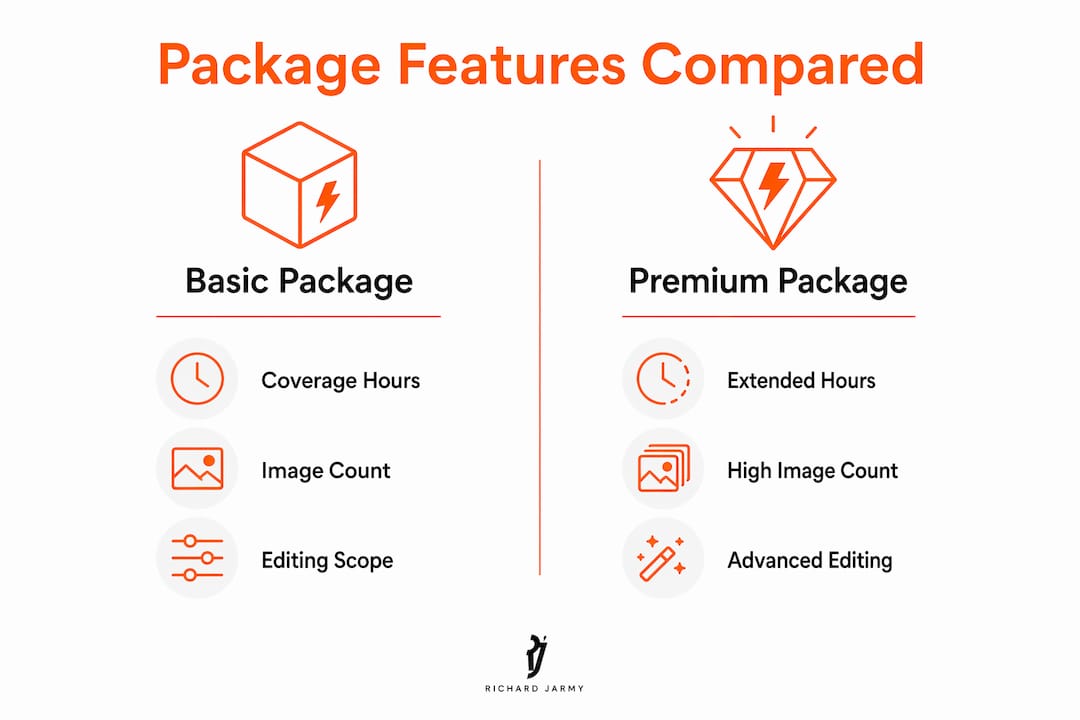
The industry term for what you are evaluating is a “photography service agreement,” though most photographers and clients simply call it a package. Either way, the components inside it are what matter. Key components to evaluate include coverage hours, image count, delivery format, usage rights, editing scope, backup equipment, pre-event consultation, and contract terms. Each of these can make or break the value of a deal.
Coverage hours and image count
Coverage hours define how long the photographer stays at your event. A package that lists “up to 6 hours” may not cover your full wedding reception. Always confirm the start and end times, and ask what happens if the event runs over. Image count matters too. Some packages guarantee a minimum number of edited images; others deliver everything shot on the day. A guaranteed minimum gives you clearer expectations.
Delivery format and turnaround time
Delivery format covers how you receive your images. High-resolution digital files via an online gallery are standard in most professional packages. Turnaround times vary widely. Some photographers deliver within two weeks; others take six to eight weeks. If you need images quickly for a corporate report or social media campaign, confirm the turnaround before you sign.
Usage rights and editing scope
Usage rights define what you can legally do with your images. Personal use rights cover sharing on social media and printing for home. Commercial use rights cover advertising, sponsor materials, and paid campaigns. Commercial usage rights are often poorly clarified at the outset, which can lead to unexpected licensing fees later. Always get written confirmation of exactly what you are permitted to do with the images.
Editing scope describes how much post-processing is included. Basic colour correction is standard. Advanced retouching, skin smoothing, or background removal are usually add-ons. Know what “professionally edited” means in the specific package you are reviewing.
Pro Tip: Ask every photographer to send you a sample contract before you book. The contract reveals far more about what is included than the package description on their website.
Backup equipment and pre-event consultation
Backup equipment is a sign of a professional operation. A photographer who carries a second camera body and spare lenses protects you from equipment failure mid-event. Pre-event consultation is equally valuable. It allows you and the photographer to align on the shot list, the timeline, and the style you want. Packages that include a consultation tend to produce better results because the photographer arrives prepared.
How do pricing models and event types influence your choice?
Pricing structures for event photography fall into three main categories: hourly billing, half-day packages, and full-day packages. Each suits a different type of event.
Professional event photography rates range from £250 to £500 per hour. That context matters when you are weighing up whether a flat-rate package represents good value.
| Package type | Typical duration | Approximate price range |
|---|---|---|
| Hourly rate | 1–3 hours | £250–£500 per hour |
| Half-day package | 4 hours | £1,500–£2,500 |
| Full-day package | 8–10 hours | £2,500–£4,500 |
| Multi-day package | 2+ days | Quoted individually |
Hourly billing suits shorter, unpredictable events such as cocktail receptions or informal parties. Flat-rate packages offer better budget certainty for conferences, galas, and weddings where the schedule is fixed. The key question is how predictable your event timeline is.
Here is how event type shapes the right pricing model:
- Weddings almost always benefit from a full-day package. The day runs long, and you do not want to watch the clock.
- Corporate conferences suit flat-rate packages because the programme is fixed and overruns are rare.
- Social parties with flexible timings often work better on an hourly basis.
- Multi-venue events may require a bespoke quote that accounts for travel between locations.
Budget for add-ons from the start. Rush delivery, same-day highlight edits, and additional photographers all carry extra costs. Factor these into your total before comparing packages side by side.
What hidden costs should you watch for when comparing packages?
Most packages include core service elements but differ in delivery speed, photographer numbers, and contract terms. Those differences are where the surprises live.
Watch out for these common exclusions:
- Travel fees. Many photographers charge mileage or accommodation costs for venues outside their local area. This is rarely included in the headline price.
- Second photographer. If your event needs two photographers working simultaneously, expect an additional fee. This is almost never bundled into a standard package.
- Social media content. Vertical crops, short video clips, and same-day edits for Instagram are typically charged as extras.
- Advanced retouching. Removing objects from backgrounds or heavy skin retouching sits outside standard editing in most contracts.
- Rush delivery. Receiving your gallery within 48 hours instead of the standard turnaround usually costs more.
Extra services such as rush delivery, advanced retouching, and social media content are standard add-ons across the industry. Always ask for a full list of what is not included before you commit.
Pro Tip: Request a line-item quote rather than a single package price. This forces the photographer to list every deliverable separately, making it far easier to spot gaps and compare fairly with other quotes.
Commercial usage rights deserve special attention. If your event images will appear in paid digital advertising or be shared with sponsors, you need written permission for that specific use. Clients should secure written rights for paid digital campaigns and third-party sponsor distribution before signing any contract. Sorting this out after the event is expensive and sometimes impossible.
Understanding photography contract essentials before you sign protects you from cancellation penalties and liability gaps that can catch you off guard.
How do you objectively select the right event photography package?
A structured process removes the guesswork from comparing packages. Follow these steps to make a fair, confident decision.
- Gather detailed quotes. Contact at least three photographers and ask for line-item quotes. A single package price tells you very little.
- Build a comparison checklist. List every component that matters to your event: coverage hours, image count, editing scope, delivery format, usage rights, backup equipment, consultation, and contract terms.
- Review portfolios alongside packages. A package that looks great on paper means nothing if the photographer’s style does not match your event. Look at full galleries, not just highlight shots.
- Match the package to your event type. A corporate awards evening has different needs from a garden wedding. Types of event photography coverage vary significantly, so confirm the photographer has experience with your specific event format.
- Factor in editing turnaround. If your images feed into a post-event report or press release, turnaround time is a hard requirement, not a preference.
- Weigh value, not just price. The cheapest package rarely delivers the most value. A professional package generally includes on-site coverage, expert editing, high-resolution files, an online gallery, and commercial usage rights. If a quote is missing any of these, adjust your comparison accordingly.
Use this checklist table when reviewing quotes side by side:
| Comparison point | Questions to ask |
|---|---|
| Coverage hours | Exact start and end times? Overtime rate? |
| Image count | Minimum guaranteed edited images? |
| Editing scope | What is included? What costs extra? |
| Delivery format | High-resolution files? Online gallery? |
| Usage rights | Personal only, or commercial included? |
| Backup equipment | Does the photographer carry spares? |
| Consultation | Is a pre-event meeting included? |
| Contract terms | Cancellation policy? Liability clause? |
Package tier labels such as Basic, Standard, and Premium are not standardised across the industry. Two photographers can use the word “Premium” to describe packages with completely different deliverables. Ignore the label. Read the line items.
Key takeaways
The most reliable way to compare event photography packages is to evaluate line-item deliverables, not package tier names or headline prices.
| Point | Details |
|---|---|
| Ignore tier labels | “Basic” and “Premium” mean nothing without comparing actual deliverables line by line. |
| Clarify usage rights upfront | Written commercial rights prevent costly licensing disputes after the event. |
| Match pricing model to event type | Hourly billing suits flexible events; flat-rate packages suit predictable, full-day schedules. |
| Budget for add-ons | Travel fees, second photographers, and rush delivery are rarely included in headline prices. |
| Pre-event consultation adds value | Packages that include a consultation produce better results because expectations are aligned before the day. |
What I have learned from years of comparing photography packages
Honestly, the biggest mistake I see clients make is fixating on the package name. They see “Premium” and assume it covers everything. It often does not. I have sat down with couples and corporate clients who were genuinely surprised to discover that their “Premium” package excluded a second photographer, travel to the venue, and commercial usage rights. Those three omissions can add hundreds of pounds to the final bill.
The pre-event consultation is the detail I value most, both as a photographer and as someone who has helped clients navigate their choices. When I meet a client before the event, I learn things that no brief or questionnaire captures. I learn how they move, what makes them laugh, and which moments matter most to them. That conversation shapes every decision I make on the day. A package that skips the consultation is saving money in the wrong place.
My honest advice is to treat the package as a starting point, not a final answer. Ask questions. Push for clarity on editing scope and usage rights. And pay close attention to how the photographer responds to your questions. A photographer who answers clearly and warmly, without making you feel like a nuisance, is telling you something important about how they will behave on the day itself. That trust is worth more than a slightly lower price.
— Richard Jarmy
Richard Jarmy’s photography packages for every event
Richard Jarmy Photography offers tailored packages for weddings, corporate events, and social occasions, with transparent pricing and clear deliverables from the first conversation.
Every package includes a pre-event consultation, professionally edited high-resolution images, and written usage rights so you know exactly what you are getting. For weddings, the wedding photography packages cover the full day with a focus on genuine, joyful moments. For corporate clients, the commercial photography packages include commercial usage rights as standard. If you are ready to find a package that fits your event perfectly, get in touch and let’s talk about what would make you smile.
FAQ
What does an event photography package typically include?
A professional event photography package typically includes on-site coverage, expert editing, high-resolution digital files, an online gallery, and usage rights. Premium packages often add same-day editing and highlight sets.
How do I compare event photography packages fairly?
Request line-item quotes from each photographer and use a checklist covering coverage hours, image count, editing scope, delivery format, usage rights, and contract terms. Ignore tier labels like Basic or Premium and compare deliverables directly.
What is the average cost of an event photography package in 2026?
Half-day packages average £1,500–£2,500 and full-day packages range from £2,500 to £4,500. Hourly rates for professionals typically run £250–£500 per hour.
Are commercial usage rights included in standard packages?
Commercial usage rights are frequently excluded from standard packages. Always request written confirmation of exactly what use is permitted, especially if images will appear in paid advertising or sponsor materials.
When is hourly billing better than a flat-rate package?
Hourly billing suits shorter or unpredictable events such as cocktail receptions and informal parties. Flat-rate packages offer better budget control for full-day, predictable events like weddings and corporate conferences.